Cross-platform search
Users can search saved AI conversations across supported providers.
Use case
User wants one searchable archive across AI providers. Be Mimos captures AI conversations locally and gives you a single searchable, exportable archive.
Product screenshot
A real product screenshot, not a mockup.
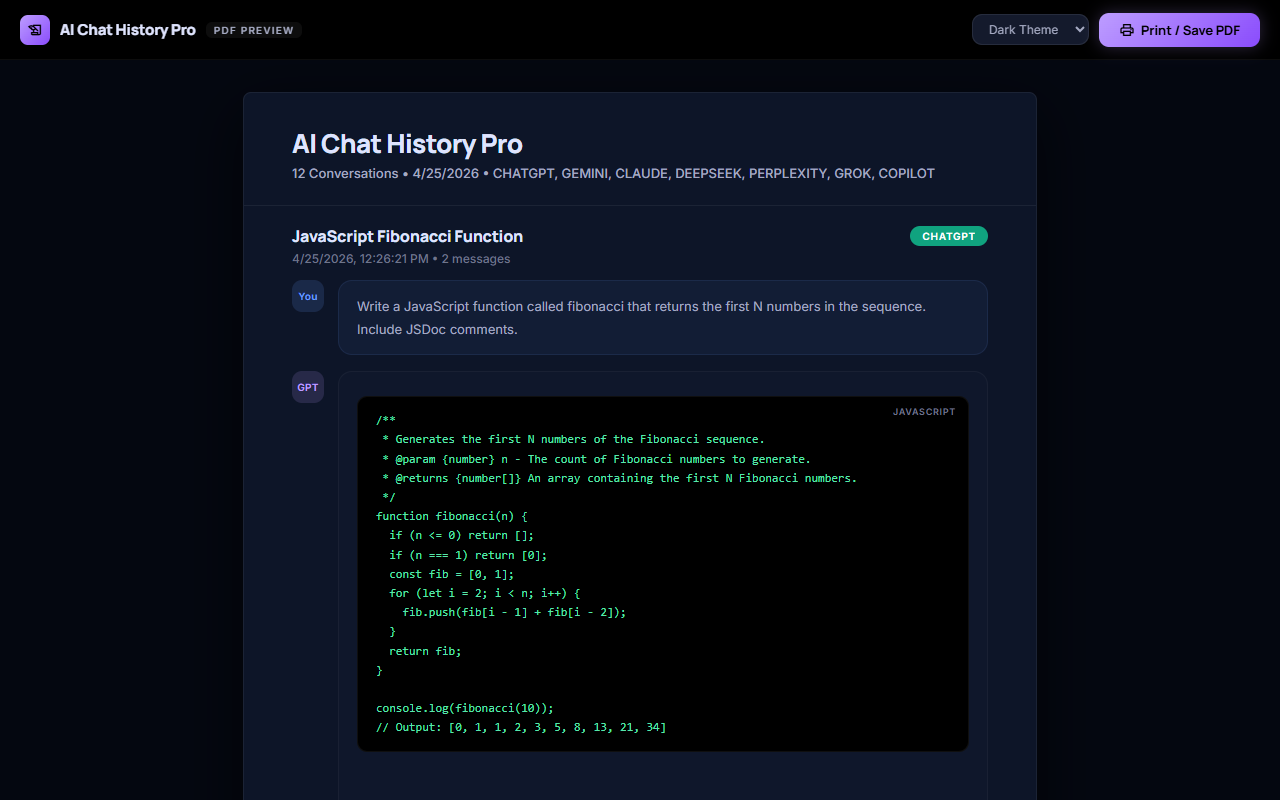
User wants one searchable archive across AI providers.
This isn't a single-platform habit — it's the same saved-history layer working the same way across every AI tool you already use, so the workflow below doesn't change depending on which provider a given conversation happened to start in.
The alternative most people fall back to — scrolling back through each provider's own history separately, or copy-pasting conversations into a personal notes app one at a time — breaks down quickly once you're using more than one AI tool regularly. A single saved-history layer that works the same way everywhere removes that per-provider bookkeeping entirely.
Grounded in what the product actually does today — not aspirational copy.
Users can search saved AI conversations across supported providers.
The product includes semantic-style search positioned as local and privacy-preserving; competitive docs describe a browser-side TF-IDF hybrid search engine with zero API calls.
Chat content stays local-first and is not uploaded to Be Mimos servers.
None of this requires a separate setup step per platform. The extension attaches once, and every supported AI tool feeds the same saved history from then on — so the workflow above is something you do inside your normal AI usage, not a separate maintenance task layered on top of it.
Beyond saving and exporting, here is the full set of capabilities this comparison is based on.
The extension saves supported AI conversations as the user chats, with manual save available as a fallback.
Users can search saved AI conversations across supported providers.
The product includes semantic-style search positioned as local and privacy-preserving; competitive docs describe a browser-side TF-IDF hybrid search engine with zero API calls.
The product includes a curated prompt library plus saved personal prompts.
Users can reuse context from saved conversations and prompts in supported AI workflows.
Saved conversations can reopen the source provider page when the original URL is available.
The product captures long-form ChatGPT and Gemini Deep Research reports.
The product extracts code blocks, images, files, and selected provider artifacts into reusable exports or ZIP bundles.
The product is positioned as extracting PDFs from Gemini and Google Drive viewer flows without extra user copy/paste steps.
The product offers local-voice read-aloud playback with optional MP3 export.
"Best alternative" depends on what you are actually trying to solve. Here is who runs into this decision most often, and why.
They use multiple AI tools and lose track of which platform produced which answer or prompt workflow.
They need searchable AI history and backup without sending sensitive conversations to another vendor's chat database.
AI research pages, citations, math, files, and long reports are hard to preserve cleanly.
Native AI share links and screenshots are hard to reuse, brand, or archive.
The same local-first capture and export workflow described above runs on every supported platform, not just the one this page is about.
conversations are captured and saved automatically, ready for search or export whenever you need them.
chats are saved the moment you have them, with export available whenever you go looking for the conversation again.
every conversation is stored locally as it happens, so export is one click away instead of a copy-paste job.
conversations are captured and saved automatically, ready for search or export whenever you need them.
chats are saved the moment you have them, with export available whenever you go looking for the conversation again.
every conversation is stored locally as it happens, so export is one click away instead of a copy-paste job.
conversations are captured and saved automatically, ready for search or export whenever you need them.
chats are saved the moment you have them, with export available whenever you go looking for the conversation again.
every conversation is stored locally as it happens, so export is one click away instead of a copy-paste job.
conversations are captured and saved automatically, ready for search or research archive whenever you need them.
chats are saved the moment you have them, with export available whenever you go looking for the conversation again.
every conversation is stored locally as it happens, so export is one click away instead of a copy-paste job.
A saved conversation is not locked to one export format. Here is what each of the other supported formats is actually good for.
Markdown is the practical choice when the conversation needs to remain readable as plain text while preserving headings, lists, links, and code-friendly structure.
PDF is the strongest fit for a stable reading copy that can be shared, printed, attached to a record, or reviewed without requiring the recipient to edit the conversation.
Word or DOCX is useful when the conversation is only the starting point and the next step is editing, commenting, rewriting, or combining the answer with an existing document.
HTML is useful when the exported conversation should be opened in a browser, inspected as a web document, or used as the starting point for a private knowledge page.
JSON is the format to consider when the conversation must be handled as structured data for scripts, analysis, backup inspection, migration, or a custom processing workflow.
CSV lays each saved message out as a spreadsheet row, useful for bulk review, filtering, or importing into analysis tools.
XLSX exports the conversation into a working spreadsheet, handy when you want to sort, tag, or chart saved messages.
A ZIP bundle groups a conversation with its extracted code blocks, images, and files into one downloadable archive.
Image export turns a conversation (or a single answer) into a shareable picture, useful for social posts or quick screenshots.
Exporting straight to Google Docs skips the download step entirely, dropping the conversation into a doc you can edit or share immediately.
Plain text strips all formatting down to the raw words, the simplest option when you just need the content itself.
ShareGPT format structures a conversation the way many fine-tuning and dataset tools expect, useful for ML training pipelines.
Alpaca format packages a conversation as instruction/response pairs, a common shape for supervised fine-tuning datasets.
Tavern format is built for roleplay and chat-model tooling that expects that specific conversation layout.
Ooba format matches the conversation layout used by the text-generation-webui ecosystem, useful if that is part of your workflow.
Yes. User wants one searchable archive across AI providers. Users can search saved AI conversations across supported providers.
Chat content stays local-first and is not uploaded to Be Mimos servers.
The product includes semantic-style search positioned as local and privacy-preserving; competitive docs describe a browser-side TF-IDF hybrid search engine with zero API calls.
Chat content stays local-first and is not uploaded to Be Mimos servers.
Available plans: Free (free), Pro Yearly ($39.99, per year), Pro Lifetime ($99.95, one time).
Sources say there is no analytics on chat content and no data mining of conversations.
Sources say there is no advertising tracking and no third-party advertising cookies.
Yes. The same capture, search, and export layer runs across all 12 supported platforms — Search all AI chat history isn't a feature limited to one provider.